Sunday, March 3, 2013

binary 0.7

binary 0.7 has just been released and compared to the current version included in the Haskell Platform, binary 0.5.1.0, it brings a few new things. Most of this has also been available in the 0.6.* versions which already have been available on hackage for some time.

Incremental interface and improved error reporting

This is probably the most requested feature, and was introduced already in binary 0.6.
In older versions of binary, you could run the Get monad with the following function:
runGet :: Get a -> Lazy.ByteString -> a
It takes the monad you want to execute, together a with a lazy ByteString containing all the input it will need to finish. While this is straight forward and easy to use, it does not meet all needs:
  1. There is no error reporting (compare with a function returning Maybe a, or Either ErrorMessage a). If a decoder error happens, it'll just call error :: String -> a.
  2. What if you don't have all input when you start to decode, like for example if you're reading from a large file or a socket? Previously, lazy IO has been used to address this, but we will look into why this is not always suitable.
To address (1), we introduce the data type Decoder as the return type for our new run function.
-- | Incremental interface to run a decoder.
runGetIncremental :: Get a -> Decoder a
A Decoder can have successfully finished in which case it'll be the Done constructor and have the final value, or have encountered a problem, in which case it'll be the Fail constructor together with the error message. In both cases, you will also get the remaining unused input, and the number of bytes consumed when the decoder succeeded or failed. In the next section, we will see why the this new run function does not need input as a second argument.

For (2), the traditional answer has been to use lazy I/O to get a lazy stream of data, which will hide that I/O is going on, and we can pretend that we already have all the input in memory. While this is fine for some scenarios, we have given up control over error handling and file handle resources. For some applications, this is simply not good enough.

Here's where the incremental interface can help. It works in the same way in binary as seen in other libraries for parsing. Instead of taking any input, it immediately produces a Decoder.  In addition to Done and Fail mentioned above, it also has the Partial constructor, meaning that the Decoder needs more input in order to finish.
-- | A decoder produced by running a 'Get' monad.
data Decoder a
  = Done !B.ByteString !ByteOffset a
    -- ^ The decoder has successfully finished. Except for the
    -- output value you also get any unused input as well as the
    -- number of bytes consumed.
  | Fail !B.ByteString !ByteOffset String
    -- ^ The decoder ran into an error. The decoder either used
    -- 'fail' or was not provided enough input. Contains any
    -- unconsumed input and the number of bytes consumed.
  | Partial (Maybe B.ByteString -> Decoder a)
    -- ^ The decoder has consumed the available input and needs
    -- more to continue. Provide 'Just' if more input is available
    -- and 'Nothing' otherwise, and you will get a new 'Decoder'.

GHC Generics

binary has also got support for automatically generating instances of the Binary class for your data types, using GHC's generics.
{-# LANGUAGE DeriveGeneric #-}

import Data.Binary
import GHC.Generics (Generic)

data Foo = Foo
         deriving (Generic)

-- GHC will automatically fill out the instance
instance Binary Foo
The was committed to binary by Bryan O'Sullivan, though pieces copied from the cereal package where it was written by Bas van Dijk.

Control.Alternative

binary now implements the Alternative class, and you can use the <|> combinator to try a decoder and fallback to another if the first failed. Although many binary formats don't strictly require backtracking in the decoder, it can be used for convenience or if it leads to code which is easier to read. In the example below, we parse frames in some binary format, trying first one kind of frames, then the other. If it's neither kind, we fail altogether.

data Frame = FrameA {- some fields specific to A frames -}
           | FrameB {- some fields specific to B frames -}

decodeFrame :: Get Frame
decodeFrame = decodeFrameA <|> decodeFrameB <|> fail "not a frame!"

decodeFrameA :: Get Frame
decodeFrameA = do
  word <- getWord8
  unless (isFrameAMagicWord word) $ fail "not an A-frame!"
  {- continue decoding... -}
  return (FrameA {..})


decodeFrameB :: Get Frame
decodeFrameB = do
  word <- getWord8
  unless (isFrameBMagicWord word) $ fail "not an B-frame!"
  {- continue decoding... -}
  return (FrameB {..})

In this particular example, though, it's not required to have backtracking, as we could have first decoded the first Word8, and then chosen to continue with either FrameA or FrameB. This continues to be the better choice for performance and should be preferred when possible, but one can imagine a more complicated binary format where using <|> is required or simply leads to cleaner code.

Control.Applicative

For each use of a primitive decoder, such as getWord8, getWord32le, and so on, binary needs to check whether there is sufficient input left, or if it needs to demand more input from the caller (by returning a Partial, as discussed above).

decodeWordTuple :: Get (Word32, Word16)
decodeWordTuple = do
  a <- getWord32le
  b <- getWord16le
  return (a,b)


Here, binary will check twice whether there is enough input. First for the 4 bytes of the Word32, and a second time whether there is 2 bytes left for the Word16. Once could think this is wasteful, and that we should only check once at the beginning for the 6 bytes that we know will be required. Unfortunately, with a monadic API this is not possible (maybe possible with some new fancy kind of rewrite rules?).
When using the applicative class though, binary tries to be clever and join these checks.

decodeWordTuple :: Get (Word32, Word16)
decodeWordTuple = (,) <$> getWord32le <*> getWord16le

It does this by using GHC's rewrite rules to rewrite the expression into a single decoder. Note that for this to make a worthwhile difference to the performance of your application, your application needs to already be quite tuned. The rewriting also relies heavily on that all decoder functions gets inlined, and can therefore be a bit hard to trigger.

Backwards compatibility

I'm pleased to say that while the internals of binary has undergone major changes, it still largely provides the same API to the developer. A few convenience functions have been added, and a few functions that doesn't make sense any more have been removed. Read the haddocks for the full API here.

Data.Binary:
decodeFileOrFail :: Binary a => FilePath
                 -> IO (Either (ByteOffset, String) a)
decodeOrFail :: Binary a =>
  Lazy.ByteString -> Either (Lazy.ByteString, ByteOffset, String)
                            (Lazy.ByteString, ByteOffset, a)

Data.Binary.Get:
runGetIncremental :: Get a -> Decoder a
runGetOrFail :: Get a -> Lazy.ByteString
  -> Either (Lazy.ByteString, ByteOffset, String)
            (Lazy.ByteString, ByteOffset, a)
pushChunk :: Decoder a -> ByteString -> Decoder a
pushChunks :: Decoder a -> Lazy.ByteString -> Decoder a
pushEndOfInput :: Decoder a -> Decoder a
uncheckedLookAhead :: Int64 -> Get Lazy.ByteString
uncheckedSkip :: Int64 -> Get ()

The functions lookAhead and lookAheadM which disappeared in binary-0.6.* and have been brought back in this release, making it easier to transition from binary-0.5.

Code

The package is available on hackage.
The code is available on github.

Contributors since the last Haskell Platform version:

  • Lennart Kolmodin
  • Johan Tibell
  • Bryan O'Sullivan
  • Bas van Dijk
  • Paolo Capriotti
  • Eyal Lotem
  • Gabor Greif

Thursday, February 17, 2011

binary by the numbers

New home

I've taken the liberty to fork the darcs repo of binary and put it on github. It contains both the latest released version as well as the new experimental continuation based Get monad a branch called cps.

git clone git://github.com/kolmodin/binary

Performance

It's interesting to run the benchmark of binary on different architectures and with different versions of GHC. Although there recently has been work within the community with fast writing (blaze-builder comes to mind) I've mostly been working on how to read things fast.

The classic binary implementation of the Get monad is a state monad while the new experimental version is continuation based, so fundamentally different. They also perform differently. To produce the numbers below I ran the benchmark suite of binary. It reads either Word8, Word16, Word32 or Word64 in a (hopefully) tight loop and then presents how fast it could do it. For example, see this graph over performance in a 32bit environment;

The nice news is that GHC 7.0.1 always performs better than GHC 6.12.3. Also the experimental cps branch (the wide green line) is faster than the classic master branch.

Things seems to be going well in 32bit land. Let's have a look in a 64bit environment;

This gives a different picture. GHC 7.0.1 still performs better than GHC 6.12.3, but we can also see that the cps branch can't keep up with the state monad based master branch (in contrast to when compiling for 32bits). Future work will include to figure out why, and how to fix it.

Lets have a look at how binary performs at writing too;

Benchmark Environment

The tests have been performed on a Sandy Bridge CPU using GHCs native backend. I wanted to try the LLVM backend too, but unfortunately LLVM crashes when compiling the benchmark executable.

Sunday, January 9, 2011

About binary

About a year ago I started hacking on a project to change the Get monad of the binary package. I've been working off and on since... :) The change will allow us to incrementally provide the Get monad with input, as well as allow backtracking and a more graceful error handling. The code was public, but got moved with the haskell.org infrastructure changes. It's now available again;
darcs get http://code.haskell.org/~kolmodin/code/binary/
Johan Tibell writes about the API update in his recent blog post. Developers familiar with attoparsec code will largely be familiar with the new binary Get monad too, as it's been a heavy influence. The type for the parse function would essentially be something like this:
data Result r =
    Fail ByteString [ByteString] -- an error msg and a trace
  | Partial (ByteString -> Result r) -- incremental input
  | Done r -- finished!
A few forks of binary tries to address this too, all in their own way. Currently I know of cereal and binary-strict.

Performance

When benchmarking cereal and the new binary package, cereal comes out on top, at the expense of not being able to consume the input in incremental chunks. I couldn't find the benchmark suit for binary-strict. The reason for cereal being faster, I think, is due to that its simpler code when having a simpler state, essentially only a single strict ByteString (the input). In binary (and attoparsec) it's a bit more complicated, due to the incremental input (in combination with supporting MonadPlus):
data S =
  S { input      :: !B.ByteString -- the current input chunk
    , next_input :: !B.ByteString -- saved input to be used when backtracking
    , read_all   :: !Bool -- have we requested all input available to parse?
    } deriving Show

newtype Get a =
  C { runCont :: forall r.
                 S ->
                 Failure   r ->
                 Success a r ->
                 Result    r }

type Failure   r = S -> [String] -> String -> Result r
type Success a r = S -> a -> Result r

bindG :: Get a -> (a -> Get b) -> Get b
bindG (C c) f = C $ \st0 kf ks -> c st0 kf (\st1 a -> runCont (f a) st1 kf ks)
Unfortunately, this results in bad performance. I'm guessing that's it's because it's reconstructing the state value (of type S), and the remaining ByteString input for each value consumed, thus a lot of allocations. So, as an experiment, I manually unpacked S;
-- No longer using S
{-
data S = S { input      :: !B.ByteString
           , next_input :: !B.ByteString
           , read_all   :: !Bool
           } deriving Show
-}

newtype Get a =
  C { runCont :: forall r.
                 -- these three were part of S, now they are separate arguments
                 B.ByteString -> -- 1
                 B.ByteString -> -- 2
                 Bool ->         -- 3
                 Failure   r ->
                 Success a r ->
                 Result    r }

type Failure   r = B.ByteString -> B.ByteString -> Bool -> [String] ->String -> Result r
type Success a r = B.ByteString -> B.ByteString -> Bool -> a -> Result r

bindG :: Get a -> (a -> Get b) -> Get b
bindG (C c) f = C $ \inp next eof kf ks ->
                             c inp next eof kf
                               (\inp' next' eof' a -> runCont (f a) inp' next' eof' kf ks)
With ghc-7, this yields a huge speed boost and reaches about half the speed of the old binary library (and ~30% faster than cereal). Unfortunately, I find the code is less readable and harder to maintain. Maybe it's worth it though. I got a hint to see ghc ticket #1349. Duncan Coutts summarizes the issue, this time about the Put monad. There are a lot of details and examples in those mails, suggesting an extension to GHC to control strictness in the arguments of higher order components. It'd allow us to write the prettier version, yet enjoying the nicer properties of the unpacked version. It's unlikely that we'll see the proposal implemented soon, though. It seems there are four options;
  • Go with the manually unpacked code
  • Drop support for backtracking
  • Drop support for incremental input
  • Find something even better, you're all invited :)

Saturday, May 10, 2008

HCAR Deadline

If you haven't followed the mailing lists lately, you might have missed that the HCAR deadline is today (10th May).
The Haskell Communities & Activities Report is a bi-annual overview of the state of Haskell as well as Haskell-related projects over the last, and possibly the upcoming 6 months. [..] If you are working on any project that is in some way related to Haskell, please write a short entry and submit it to the us. Even if the project is very small or unfinished or you think it is not important enough -- please reconsider and submit an entry anyway!
Get the full details here. I'm much looking forward to the next edition!

Sunday, January 20, 2008

The Beginning of a New Era

I still remember the event Jobs in Functional Programming, held here in Göteborg, Sweden, the 14th December last year. It was the first event of its kind, an event to attract hackers to employers, paying for you to hack in functional programming languages! Not only were 8 companies represented in some way, 6 of them had people there explaining why you should go to their company and not someone else's :) With over 100 people registered, and about as many as came, it was a joy. Professor John Hughes, well known for his work with Haskell, was the host for the evening. John ended the event with a speech, I got reminded of it by SPJ's mail. Congratulations, btw! :) They both conclude that Haskell has become much more popular, and that it has happened very fast. Five or ten years ago we would not have dreamed of having such an event as we did. Some students found it humorous when John spoke very enthusiastically about Haskell's new won popularity. But think of it this way, twenty years ago few companies would make a fuzz about FP at all. Today C#, one of the most popular languages out there from one of the (the?) biggest computer companies out there, has lots of ideas from FP. There is also F#: Microsoft's newest addition to the .NET family, a somewhat more evolved version of OCaml, adjusted to fit into the .NET world. It's not difficult to make the prediction that Haskell will get even more attention in the near future. The times are really changing. As Hughes said in his speech, this is the beginning of a new era.

Saturday, January 19, 2008

Wireless on a Thinkpad x61s

I've just configured wireless networking on my laptop, so I'd like to share a little checklist to speed up the process for others in the same situation. As you will see, it is that hard to get it going. It's as simple as setting the kernel modules, drivers, encryption and local settings. What took me the longest was actually to remember to allow my MAC address in the router... bummer :) This guide is specific to Gentoo Linux, but it should not differ too much against other distributions. I also expect you are familiar with Gentoo and how to compile your kernel. # lspci | grep Wireless 03:00.0 Network controller: Intel Corporation PRO/Wireless 4965 AG or AGN Network Connection (rev 61) First, we need to get the network interface working. Enable the new network stack, in the kernel menuconfig, enable Networking -> Wireless -> Generic IEEE 802.11 Networking Stack (mac80211). I used the currently latest stable kernel, gentoo-sources-2.6.23-r3 Also don't forget to compile the required crypto algorithms under Cryptographic API: <M> Cryptographic algorithm manager <M> CBC support <M> ECB support <M> AES cipher algorithms <M> ARC4 cipher algorithm <M> Michael MIC keyed digest algorithm <M> PCBC support This will build modules called mac80211, blkcipher, aes, arc4, ecb, cryptomgr and crypto_algapi. Load them during boot in /etc/modules.autoload.d/kernel-2.6. Also modprobe right away, so we can continue without rebooting. Add to kernel-2.6 like above. Install the network drivers; unmask and unhardmask iwlwifi and iwl4965-ucode, add ipw4965 to your use flags, then run emerge iwlwifi This will install the iwlwifi system and the firmware needed by your hardware. Now run modprobe iwl4965. Check success/failure with ifconfig -a or dmesg, you should have a new interface available. As soon as you've got the interface up and running, check your HW address. If you've got MAC filtering, don't forget to add it to your "Allow list". Better get that out of the way so we don't forget it... I'm using wpa_supplicant to configure for my networks, emerge wpa_supplicant. /etc/conf.d/net: ---------------- #dhcp is default on all devices modules=( "wpa_supplicant" ) wpa_supplicant_wlan0="-Dwext" /etc/wpa_supplicant/wpa_supplicant.conf: ---------------------------------------- ctrl_interface=/var/run/wpa_supplicant # Let any member of the group "wheel" configure the network ctrl_interface_group=wheel ap_scan=1 # Add network block to connect to unsecure networks. # Giving it a low priority will make all other blocks preferred. network={ key_mgmt=NONE priority=-9999999 } # Add a WPA2 network network={ ssid="my ssid" proto=WPA2 key_mgmt=WPA-PSK psk="secret password" } More information about wpa_supplicant, and examples, are available in /usr/share/doc/wpa_supplicant*/.

Thursday, August 23, 2007

Crap mail client

At work we're blessed with a wonderful mail client which we are suppose to use, by policy. And most people do. I try not to. Maybe you've seen this signature in some peoples' mail:
A: Because it messes up the order in which people normally read text. Q: Why is top-posting such a bad thing? A: Top-posting. Q: What is the most annoying thing in e-mail?
and indeed they are right. This particular mail client encourages top posting by doing two things. The first one is that when you hit reply it formats the new mail in this manner: <cursor here> <your signature> ------<other persons name> wrote:------ <other persons mail body indented> ... where the irritating thing is that it places your signature above the other persons mail. The second thing is that all mails are in HTML, and the client has some limitations in that regard: The text from the mail you're replying to gets indented in a way where you can't inline your replies without having your text indented too. The interesting stuff happens when people in my organization think of how to workaround these limitations. Some use top posting, and forgets to reply to half of the message. The others use a feature that comes with HTML, coloring! That is, the common way to reply is that you pick a previously not used color in that mail, and color your inlining with that. When the mail gets replied for the seventh time there is indeed eight different colors used, and everything is indented seven steps. Yay.... Naturally there is no "standardization" of which color to pick next, so each conversation is colored in a different way. It can get quite tricky to follow. Also, after a while it gets hard to pick a color that is sufficiently different from other colors. Luckily I'm not color blind. Just to make you realize how bad this really is, imagine this with your favorite indention sensitive programming language: In your editor;
  • You can't indent.
  • When you hit the tab key you just get the color for the current indention level.
  • The mapping of "intention level" to color is different for each source file.
A very interesting thought. The first person to implement this in the editor of their choice will get a postcard from Göteborg, by yours truly.

Friday, June 1, 2007

Code vs. Coder

I read a blog this morning, which got a few thoughts started (oh noes, not again!). Rich Skrenta argued that code is our enemy while Jeff Atwood replied that the code itself isn't the problem, but that the real problem is what you see in the mirror. This reminded me of the good professor John Hughes (who taught me Haskell 5 years ago!), who has along with Koen Classen and others, been writing on QuickCheck the past years. It has been rewritten a number of times, each time with more features but fewer LOCs (lines of codes). Bearing in mind that counting LOCs is regarded as a measurement of productivity, Hughes asks,
Have we had negative productivity? We do more with less code!
Another example would be in the newly released xmonad 0.2 where Don (dons) Stewart recently blogged about how he with fewer lines of code did more by moving some of the logic into the data structures. He used a technique called zipper (references in the end of his blog entry) and could thus merge two data structures into one, eliminating the problem of keeping them concise. Easier to write the code and less risk of writing bugs. Did he have negative productivity too? I would have to say no. Written code has to be maintained by someone, depending on what it was written to do. When GHC 6.6 was released the Gentoo Haskell Herd got busy as roughly half of the Haskell packages only compiled with GHC 6.4.2 (about 16 broken out of 40). Naturally we wanted them to work with GHC 6.6 too. It is hard to foresee what will change, no matter how you write the code, thus giving Skrenta a point. Code is the enemy. Reason for the broken packages (2) mostly was (in no particular order)
  • deprecated modules and classes
  • functionality moved to other modules
  • changed type signatures
  • changes in the type system?
  • changes in the build system
  • UTF8 trouble
All this makes me extra jumpy when Erik Hellman, a Java Consultant in Göteborg, blogs about when a 1400 lines game written in 50 min (in Swedish) which was later presented at the JavaOne conference. 500 lines are auto generated getters/setters, along with 900 manually written lines. Assuming writing the manual lines took 40 min, he wrote a line about every three seconds non-stop. I hardly think though that I even could write 900 lines in 40 min even by heart. He agrees, and notes that this is not possible without an IDE, in which case he recommends IntelliJ IDEA 6.0. Maybe Hellman is an extremely talented hacker and that his tools indeed are excellent, thus it's not possible to write the code in less than 1400 lines (in Java) and that it really should have taken some other programmer the whole day. Possibly the job has been solved and no one has to touch the code ever again. Personally though, I would be more interested to see how the game would evolve in 50 hours, days, or weeks. I guess it depends on what you want your app to do. Still impressive to write a game like that in 50 min, but 1400 LOCs? Hellman replies by saying that we are on the same track, and that we should see the other guy's code. How much logic can you write in 40 min? The resulting massive amount of code does not seem to be a problem. I guess that we just have different backgrounds. I have not yet had a look at the code, which recently was put online, but I do hope that the IDE will help to debug and maintain it. This raises the question of how many lines it would be in Haskell, given the corresponding libraries exists. Anyone want to give it a try?

Thursday, April 19, 2007

Pepper

I've been thinking (oh noes!)... Peppers are hollow, but what's actually inside? Is it simply air or perhaps some gas secreted while growing? Assume it is air, is it then air from where the pepper is grown, or from a more recent location? If the "filling" is indeed from where it's grown - let's say Croatia (I've got reliable intelligence that the best tasting vegetables are grown there): If I'm lucky, I might just manage to carefully make a couple of holes in the pepper, breath in, and get a small breath of this mysterious gas. That's a mini vacation right there!

Vårt svenska språk

Only in Swedish... Fick en fråga av en kollega: Varför heter det att man "ligger i lumpen", "sitter i fängelse" och "går i skolan"? Nästan Anders och Måns-kvalitet på den. Men hur kommer det sig? Ligga i lumpen; motiverat med allitteration... Sitta i fängelse; man kommer ingen vart? Sitt still! Går i skolan; det går framåt? Err.. Hm..

Asking for a day off?

Hittade en lapp på jobbet som förklarar varför man inte kan få ledigt om man ber om det...
Vet du vad du egentligen begär? Året har 365 dagar, men du arbetar ju inte varje dag. Under årets 52 veckor har du ledigt 2 dagar varje vecka. Då återstår 261 dagar. Du är ledig 16 timmar varje dag, det blir sammanlagt 170 dagar. Då återstår 91 dagar som du kan arbeta. Varje dag tar du lunch 1 timme, det blir sammanlagt 48 dagar. Nu återstår 43 dagar. Du behöver inte arbeta 6 röda dagar under året. Det blir 37 dagar kvar. Varje dag tar du kafferast 10 minuter, det blir totalt 11 dagar. Kvar finns 26 arbetsdagar. Sedan har du 25 dagars semester. Då återstår bara en dag. Och den förstår du väl att du inte kan få ledigt.
Which (loosely) translates into: I found a note at work why I can't have the day off. (Notice that this is is with Swedish vacation, 5 weeks each year).
Do you even know what you're asking? Each year has 365 days, but you're not working all of them. For each of the year's 52 weeks, you've got 2 free days, leaving 261 days. Being free 16 hours a day adds up to 170 days. 91 days left to work. Add up 1 hour lunch each day, that's 48 days. 43 days remains to work. You don't have to work the 6 holiday-days, 37 days remains. 10 minutes coffee break each day adds up to 11 days. Left is 26 days to work. Then you have 25 days vacation. Only one single day to work. Now you must understand you can't get that day off?
I don't really get the numbers to add up, but hey! :D

Monday, April 16, 2007

RIP rydis

Martin "rydis" Rydström disappeared the 24th February earlier this year. His body was found last week in the water outside of Göteborg. Martin was a fellow lisper, which I only met irl one single time. I regret I didn't get to know you better. We will remember you, friend.

Thursday, April 12, 2007

Fun at work

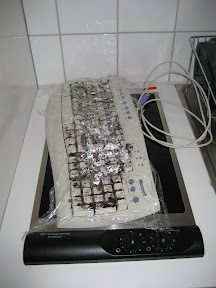
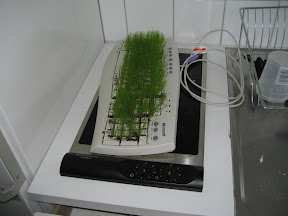
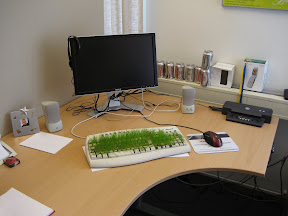
Imagine my face when I walked into the kitchen at work and saw a keyboard with dirt all over it, well wrapped in plastic film. Is it supposed to be there? What happened and who did it? While taking another cup of tea, I recalled an old prank I've seen circulate the net. Ah! Five days later, it had progressed nicely... Looked like a green carpet. Nicely set-up. Guess if he was surprised? What would you say if your office looked like that after the easter holiday? Oh yeah. All you need is an old keyboard, some dirt or cotton, and seeds of something easy growing. Childish humour can be an asset too. Complete instructions on the other site. This is yet a reason why I choose to write the report of my thesis at work instead of at home :D Now back to work!

Monday, April 2, 2007

xmonad

If you've followed #haskell@freenode the last month, you've had to try hard to not hear about heard about xmonad. It's a lightweight window manager, a clone of dwm, similar to ion, ratpoison, wmii and larswm. To be more precise it's a tiling window manager which means that it makes sure that no windows are overlapping. It can take a while to get used to, but it's well worth the effort. While xmonad still is relatively easy to learn, the Ion manifest still applies. It will help you to put down the mouse. The impressive part is that while one of dwm's goals is to be <2000 lines of C, xmonad has similar features in <400 lines of Haskell. It also does a couple of things dwm doesn't, namely automated testing of the internal window manager properties (with QuickCheck) and support for xinerama. (The lack of xinerama is, otoh, listed as a feature of dwm). See a screenshot here. It's not yet released, so you'll have to "darcs get" the sources, instructions on the homepage. Unless you're running Gentoo Linux with the haskell overlay, in which case a "emerge xmonad-darcs" will do. Give it a try and give feedback on #haskell!

Wednesday, February 7, 2007

Fish out of water

I've been forced out of my safe zone and into Windows. It came with the job... Now, 6 months later, I've collected a few tools that makes the daily headake set a little later in the afternoon. True X-Mouse: The first thing I missed was beeing able to copy and paste simply by selecting and clicking. Fortunately, True X-Mouse solves that. Open Command Window Here: Part of the Microsoft PowerToys for Windows XP. Right click on any folder and select "Open Command Window Here" and you'll have a cmd.exe with CWD as that folder. Must have saved me hours of typing... Perfect if you use darcs as version control system and need to type a few commands. GnuWin32: Don't like the Windows Search function? Neither do I. I miss my bash shell, and the coreutils :/ Imagine my smiling face when I found a port of many common GNU tools. You can get far with the coreutils and grep package. Virtual Dimension: Another thing that's hard to live without is virtual desktops. I use them all the time on my linux boxes, and constantly hit the keys to switch desktop even on windows machines. This tool makes a pretty good job at faking virtual desktops, but you do notice that it's not real virtual desktops. If (when!) a program hangs, it will appear on all desktops, and if you're unlucky you're stuck on your current desktop for a while. Still a great tool, I'd probably miss this one the most of them all. Vim: You don't get very far with notepad or wordpad. Using vim in cmd.exe is just weird as cmd.exe is far to crappy. GVim works perfectly though. Emacs is available too if you're into that kind of thing. Putty: Putty is your new SSH client. Nice! Winrar: Opens your .tar.gz and .tar.bz2 (and a bunch of other) files, yay! Daemon tools: Mount your CD images as virtual cdrom drives. Browsers: Same same... I use both Firefox and Opera. With a few of these tools your Windows experiense won't be as frightening, and you might even get some work done instead of just being frustrated. Bonus: All these tools are free (as in beer). Although I hope that none of you ever need to use these tools, I wish you good luck!